AT-node revisited: explore the data on typing with assistive technology

Our free AT-node for access website is back up and running. How fast can people with physical disabilities type when using different assistive technologies? Use AT-node to get evidence to enhance your understanding.

AT-node is a website that organizes the available research evidence on text entry rates (typing speeds) for people with physical disabilities. We built it a few years ago, and recently it had not been working due to necessary platform changes. I finally got around to fixing it, and now you can run AT-node for Access again.

Continue reading “AT-node revisited: explore the data on typing with assistive technology”
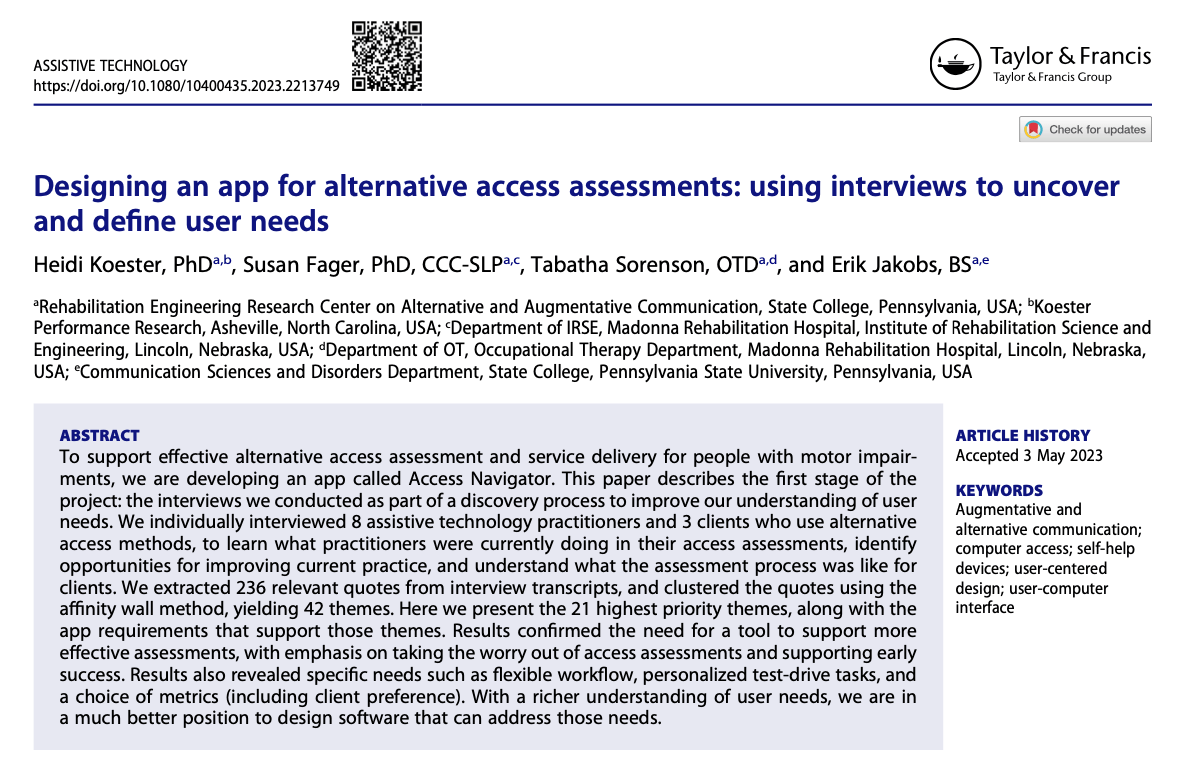
Designing an app for alternative access assessments: new publication!

Happy to announce that our new article just came out in the Assistive Technology journal! Read on to learn how we involved users when designing our Access Navigator app for alternative access assessments.

Masthead of publication
Continue reading “Designing an app for alternative access assessments: new publication!”

Highlights from the RESNA 2021 Conference

The RESNA 2021 conference: 2+ days packed with learning, sharing, and networking in assistive technology. Here are some highlights (and links to my own presentations).

Highlights of RESNA 2021 Conference
Continue reading “Highlights from the RESNA 2021 Conference”

Join me at the RESNA 2021 Conference

Don’t miss the RESNA 2021 Virtual Conference, July 7-9, 2021! Registration deadline is Friday, June 25, 2021. I’ll be part of three presentations (more on these below). Hope to see you there!

Join me at the RESNA 2021 Virtual Conference
Continue reading “Join me at the RESNA 2021 Conference”

ATIA 2021 – Day 1 highlights and how you can still register

The ATIA 2021 Conference is all virtual, but it’s still got an engaging and educational roster of presentations and exhibits. It’s going on now, January 25 – February 6, but there’s still time to register. This post shares some highlights from the first two presentations I attended along with info to help you register.

ATIA 2021: Day 1 highlights and how you can still registerThe ATIA Conference is always a highlight of the assistive technology calendar. This year’s version is all virtual, and the organizers have worked really hard to create an engaging and educational roster of presentations and exhibits. In this post, I’ll share some highlights from two presentations I attended on Monday Jan 25, and let you know how you can participate in the rest of the conference if you’d like.
Continue reading “ATIA 2021 – Day 1 highlights and how you can still register”

New mega-review of literature on AT and education

Dave Edyburn spent the last year reviewing over 900 articles on assistive technology and education. He shared the findings in several reports, and even compiled a database of all the articles. Read on for details!

New mega-review of literature on AT and education
Continue reading “New mega-review of literature on AT and education”

Plan today for RESNA and ATIA 2021 conferences

Make your plans now for two of the best assistive technology conferences coming up in 2021: RESNA and ATIA. Be part of the RESNA conference program by submitting a proposal by Nov 30. And registration for the Jan/Feb 2021 ATIA conference is now open. Read on for details.

Continue reading “Plan today for RESNA and ATIA 2021 conferences”

Access Assistant: a new KPR project funded by NIDILRR

Koester Performance Research is a partner in the newly-funded Rehabilitation Engineering Research Center on Augmentative and Alternative Communication (the RERC on AAC). KPR’s projects focus on ensuring effective and efficient physical access to AAC for people with severe motor impairments.

Photo of a man using a switch to access a computer. Text says Access Assistant: a new project funded by NIDILRR

Continue reading “Access Assistant: a new KPR project funded by NIDILRR”

How to do a remote assistive technology assessment

Because of Covid-19, there’s a greater need for assistive technology practitioners to conduct remote assessments. This post presents a method used by occupational therapist Charlie Danger to assess for eyegaze access remotely.

How to do remote assistive technology assessments. Photo of Charlie Danger in front of two computer monitors: one showing a client's face and one showing the client's on-screen keyboard.
Continue reading “How to do a remote assistive technology assessment”